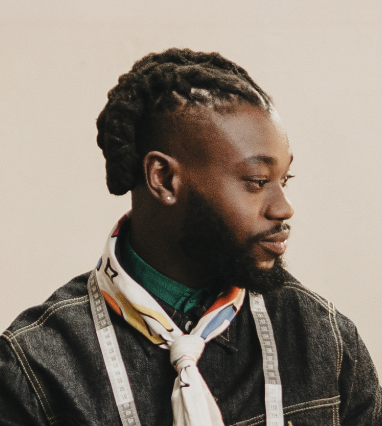
inda Flo is a disc jockey, radio host, and event promoter going deeper underground in the club and rave scene to bend and blend cultural sounds in her stomping ground of Global Bass, Techno, Percussive Club, Electronic, and World.
Her sets guarantee a nonstop high energy that reach across borders of Asia, Africa, Latin America, The Middle East, The Caribbean, Europe, and the diasporic world.
inda Flo has founded the club night and rave event Hold The Door, showcasing underground global sounds.
Across the airwaves, she's a resident on Voices Radio and has made special guest appearances on NTS, Rinse, Balaami, Foundation FM, Reprezent, and Soho Radio.
INTERVIEW
How would you describe the emotions or energy you try to bring to your sets?
INDA FLO: As a teenager, I was fortunately surrounded by music and people playing music and as a raver I was part of a strong underground subculture of Drum and Bass. At some point I sensed I had good taste in and an understanding of music that enabled me to play it better than the average person. I give thanks to my African ancestry for my intuitive rhythm and taste. It was this intuition, my obsessive love of music, and the way music saved me from a difficult childhood that attracted me to DJing as a 15 year old kid and again in my early thirties.
Over my lifetime my taste has evolved. My entry point into electronic music was Drum and Bass and Jungle which, with the exposure of my time at university, grew into different types of global music ranging from Afrobeat, Balkan Folk, and Reggae. After university, as a result of my travels, I got into Reggaeton and Champeta quite obsessively which became gateways to other types of global Electronic music. As a DJ, I started out playing Global Bass, Percussive Club and World music which was a natural evolution from what I’d been listening to up until that point. And then I saw a DJ called Fiedel play a three hour Techno set during the summer of 2024 which completely indoctrinated me into Techno. I fell in love with its stomping rhythm and so as a DJ (and a raver) I converted. Regardless of how my sound evolves, what has always remained a constant or common thread is the cultural diversity of my sound and so whether it’s Bass or Techno, my signature sound will always bring a global dimension to it.
How would you describe the emotions or energy you try to bring to your sets?
INDA FLO: I love music and so if I’m not dancing during any of my sets then generally speaking, something is off. That’s a tell tale sign for me. So high energy and full expression are frequencies that shape how I play the music I play. I’m usually playing high-energy sets because I want to help people to sweat off the daily grind of work and life. A guiding principle of mine is “leave it all on the dancefloor” and so my sets are part exercise, part exorcism.
Divinity is another energy I’m drawing from in my sets because music is magic to me and so my music is a reminder of how sacred the world and life are.
Although not necessarily an emotion or an energy but certainly an intention, my aim as a DJ is to leave humans changed on a cellular and spiritual level. I want the bass, the loops, the beat, the depth, the euphoria, and the arc of my sets to release and rearrange a dancer’s molecular makeup. I’ve experienced this a few times in my life with DJs including Fiedel, Deena Abdelwahed, and most recently Batu. I can’t articulate how but I left those dancefloor experiences changed. That’s the level of mastery, mystery, and magic that I want my music to create in people, for people.
Are there any particular artists, cultures, or experiences that have shaped your musical identity?
INDA FLO: I think culture is the main shaper or influencer of my musical identity. My globetrotting and cultural experiences have heavily contributed to my love of World music and so my sound is often aiming to go as far and wide as possible when it comes to global sounds. I often talk about my music as being an exploration of underground sounds from Latin America, Asia, Africa, SWANA/The Middle East, The Caribbean, Europe, and the Pacific Islands - and that’s because of my exposure to these regions through my physical journeys or through my enjoyment of international cinema and literature that can transport me to parts of the world I’m unable or yet to visit.
What’s your approach to curating a mix — do you follow a structure, or is it more instinctive?
INDA FLO: So for the first few years of my DJing, I structured my sets quite intensely. The reason being, that I really enjoy the experience of putting a mix together. I love the experience of almost piecing a puzzle together or crafting a journey’s arc - it’s quite an addictive experience! I’ll start with putting a few tunes together and before I can stop myself, I’ve finished the set. And I think because I have a good instinct about what a type of crowd wants at a certain time, in a particular club, with a specific vibe - then structuring my sets has helped me to really make good on going on a musical journey that works in desired yet unexpected ways.
These days, I improvise much more for a few different reasons. One reason is maturing as a DJ and recognising the need to hold my sets more loosely so I can be fully present and attuned to what the crowd wants and needs in the moment. Another reason is because my sound has transitioned into Techno, that gives me much more time to blend my selections more slowly and subtly in real time. Thirdly, as a busy human, I realised that I can’t keep spending lots of time planning my sets even though I really enjoy it as a pastime. And so nowadays I improvise a lot more during my sets which has also required me to trust in my skill, my reflexes, my antenna, and my intuition.
I don’t think either approach (structured or instinctive) is better than the other - they’re just two different ways of creating the outcome of getting people to dance. To each their own in how they go about doing that.
How do you balance playing what you love versus what the crowd expects?
INDA FLO: I’m not a massive crowdpleaser when it comes to playing what people “expect” me to play. The way I embody my role as a DJ is introducing people to seldom heard sounds (often from different parts of the world). So you won’t find me playing banger after banger of all the singalong songs or club classics.
But I can be flexible within my sound and recognise the moments where it’s cool to give the people what they want. If I get a request and I have the tune and it fits with the vibe then I’m happy to play it. I’m not super precious about stuff like that because I’m in service to the dancefloor, not the dictator of it. Interdependence is a really important value to remain humbled by because the DJ needs the crowd just as much as the crowd needs the DJ and as soon as either forgets that or the balance of co-creation is off, then the quality of the dancefloor is compromised. The beauty is in the balance, and I try to always wield it with intention, gratitude, humility, and trust.
Is there a particular genre or sound you’re currently exploring or excited about?
INDA FLO: At the moment I’m really building my signature sound of Global Techno where I play Techno music from different parts of the world. European Techno can be quite cold or hard, but I love to blend it with global sounds in ways that add soul, flavour, and warmth. I play a lot of Arabic and Latin Techno and there’s a lot of incredible creativity out there. Some of my favourite producers are Acid Arab, Villaseñor, DJ Babatr, Dusty Dan, and Deena Abdelwahed. I’m carving out this subgenre as a niche sound through my monthly radio show called Techno World Music (you can find it on my Soundcloud) as well as bringing the sound to my sets. I’m also loving celestial techno (aka heavenly, otherworldly, hypnotic techno) which brings a level of depth and divinity to my sound that my spirit really needs and that I want to inspire in others. The way I describe myself is that I am divinely called to build, bridge, and blend worlds of sound and spirit, of culture and cosmos, across waters and beyond borders.
The music industry can be intense. How do you take care of your mental and emotional well-being?
INDA FLO: I think there are two key things that support my mental health and wellbeing. One is my practice of radical gratitude. Everything that I’m able to achieve is a bonus and every milestone that I reach is a milestone that once upon a time I could only have dreamed of. Reminding myself of this whenever I’m falling into comparison, insecurity, or competition helps me stay grounded and connected to why I love doing what I’m doing and the miracle that I get to do it at all. I’m grateful to the God-universe for conspiring on my behalf. Anything less than radical gratitude is a level of entitlement that isn’t in service of my joy, awe, and wellbeing. The second thing that helps me take care of my mental health is resting when I need to rest. This is a learning journey that I’ll probably always be on because my tendency is to be an overachiever in anything I care about. But I know myself pretty well (and I have amazing mentors to also help me see myself) so when I’m too tired for my heart to really enjoy the music then I know it’s probably time for me to take a break and rest. This was a recent decision which resulted in me taking three months off DJing and it was the best decision I made because I got to immerse myself in other joyful aspects of my life including the mundane act of just sitting on the couch without having to be anywhere.
What keeps you inspired and motivated when you hit creative or personal challenges
INDA FLO: My inspiration and motivation in times of challenge is my duty as a human being who is part of something much bigger than myself. I’m playing for a deeper meaning and higher purpose than just hands in the air or some kind of instant gratification. My inspiration for music is deeply spiritual, it’s a way for me to connect to the God-universe and translate its magic through the language of sound. That kind of inspiration is an infinitely renewable energy source, much like my creativity. When I hit some kind of creative or personal challenge, I practice trusting in my process, including when I feel unsure, stuck in a rut, or downright frustrated. These uncomfortable emotions are part of my process too and they’re data for what I need in that moment or what I decide to do next. The challenge creates a level of friction which generates energy for a deepening of my art. My work is constantly learning how to wield it in service of what I’m creating or whatever lesson is waiting for me to learn. I’m not saying I’ve mastered this properly but I do find that I’d be bored without challenge and so I’ve learnt to not only appreciate them but use them as a launchpad for the next evolution or mutation of my music.
Beyond music, how do you see yourself in the world—what drives you and your purpose?
INDA FLO: Beyond music my vocation is activism. So much of what purposefully drives me is the question of how to transform the status quo of oppression, dehumanisation, and supremacy that shapes so much of the world. Supporting human beings to find freedom within themselves in ways that transcend the never-ending hierarchies we create between us is a big part of what I’ve been called to do. I want to create the conditions for humans to decide to become ungoverned by man-made systems of oppression and social constructs that are only designed to divide and conquer us. My unique contribution is building our capacity for co-existence and co-resistance, for diversity and difference, and ultimately for collective liberation.
Have you faced any challenges in the industry that shaped the way you approach your craft?
INDA FLO: One of the most obvious challenges that I’ve experienced was being booked to play the festival Field Day in 2025 as part of a Sisu stage takeover. That booking was my first major opportunity to break out as a baby DJ. I was over the moon about it until I found out that Field Day is owned by Superstruct which is owned by KKR (a private equity fund that has an investment portfolio complicit in the longstanding Israeli genocide of the Palestinian people). What should have been a really exciting opportunity became a 6 month political campaign that resulted in Sisu boycotting the festival and influencing most of the Field Day to do the same. There’s much more I could say about how challenging it was to lead that campaign and navigate the risks of doing so in such a hypervisible way - especially as an artist early in my career. However, it shaped my craft by posing the question: what kind of artist do I want to be? And the answer is one of integrity, courage, and compassion. I want to be an artist who holds the mirror up to the world and helps bend the moral arc of the universe towards justice (in the words of Dr Martin Luther King). Ultimately I want to be remembered for being willing to stand in solidarity and speak truth to power over any kind of “industry success”. My craft is rooted in our shared humanity.
How do you navigate spaces where you might feel underrepresented or overlooked
INDA FLO: No I don’t. I think electronic music has become more of an aesthetic than a meeting place - and that aesthetic is getting more and more narrow with the Techno scene being a prime example of this. I find it weird because music is not an identity or a status - I experience it as more of a technology or a gift from God. And yet, social media has turned it into a fashion accessory or a status symbol. I’ll never buy into this trend.
Another way electronic music continues to be exclusionary is the lack of inaccessible venues for disabled folx - it’s an injustice that seems so embedded in the electronic music scene and doesn’t look like it’s changing anytime soon. I find the lack of legislation requiring and resourcing venues to be wheelchair-accessible to be very telling of what and who we deprioritise in our society. Of course there are other disabilities to also consider, not just physical, but across the board I’d say that change is too slow.
Finally I think another exclusionary dynamic is the commercialisation of the underground which is driving ticket prices up in unprecedented ways. To see club night entry fees costing upwards of £20 on average is mind-boggling. The impact of this is that it excludes financially precarious people who want a good time but can’t afford the stacked up costs of tickets, drinks, travel, and so on. Obviously there is still a lot of grassroots partying that is done on a shoestring (innovation in the underground has always been born from structural forces such as policing, venue closures, and systemic oppressions to name a few. But it’s important to recognise that while there has been a democratisation of music through streaming, technological advances, and weirdly Covid lockdowns - there’s also a homogenisation of crowds on the dancefloor which breaks my heart. The dance floor is a sacred meeting space that belongs to everyone, not just the cool kids, the able-bodied kids, the straight kids, or the rich kids alone. We need to do better and there’s much to be done.
How do you navigate spaces where you might feel underrepresented or overlooked?
INDA FLO: The way I navigate spaces like these is to minimise the amount of time I have to navigate them at all. I just remove myself from these kinds of spaces because they don’t serve me, no matter how shiny they may seem. In the end, I’m not getting anywhere forcing myself to be in these kinds of spaces because I’ve made some meaning about what that space symbolises - which is often nothing more than a story. I’ve learnt to unhook myself from the dependency of being recognised or accepted by certain spaces or gatekeepers - my success isn’t defined by their gaze. My success is defined by me and my ability to carve my own path. When I encounter a space that doesn’t want to open itself up to me, then the question becomes less about how I can survive in that space and more about how I can build alternative spaces of my own that preserve my autonomy, creativity, freedom, and humanity.
If you could create your dream lineup for an event, who would be on it?
INDA FLO: I love this question so much because it inspires me to dreammmm. So for my dream club night, we start late and finish late (British clubbing generally finishes way too early for me - I prefer later licensing like in Germany or Spain). Awe-some lighting and visuals are a must. Bathrooms need to be plentiful, private, and pristine. And the crowd is there to dance. And so my dream lineup would be (in no particular order): Deena Abdelwahed b2b Batu; Acid Arab; Fiedel; Dr Breinner b2b Maukook; Ma Sha; Nicola Cruz; and Zaatar. All of these artists have moved my dancing spirit in mysterious ways..
What’s a festival, venue, or city you dream of performing at and why?
INDA FLO: So until a few weeks ago, I would have said Field Maneuvers - a small, “no-frills”, queer festival that happens over 3 days every August somewhere in Norfolk. I’ve been going for 5 years now and for at least 3 of those years it’s been my dream to play there one day. I fell in love with its lowkey attitude and commitment to silly-stupid fun while maintaining principled politics that advocate for collective liberation. Also being able to travel from the middle of the dancefloor to my tent in less than 10 minutes is exactly the kind of easy intimate festival that suits me so well. So like I said, a few weeks ago I would have said Field Maneuvers as the festival I’d dream of playing at but I’m happy to share that a few weeks ago, my dream came true and I got booked to play! I’m over the moon! I’m playing my favourite tent on my favourite day with a great set time amongst a lineup of giants. I can’t believe it happened!
So my next big bucket list dream is Waking Life in Portugal. I think this will take me at least another handful of years to make a reality. The reason I’d love to play here is because musically, it’s a place where I experience pure mastery - served with an abundance of mystery, magic, and mischief that’s hard to describe unless you’ve been there and lived it. I also really love the political and spiritual ethos of Waking Life - the way it so intentionally stewards the land and water that it lives on. Waking Life is an entire world that I’d love to musically be a part of.
Outside of DJing, do you have any creative or personal projects you're passionate about?
INDA FLO: At the moment I’m trying to downscale my life and have less going on. I’ve spent years working very hard on co-founding my company which is dedicated to social justice. I’ve had a constant of passion projects that nourish my creative mind, body, and soul - but they also take up a lot of time to the point that I never had a spare evening to just chill on the couch. So my personal project right now is rest and balance. Less doing, more being. Part of this has unexpectedly translated into me reading more poetry which is really refreshing, especially after one too many years of non-fiction. A few passions that have stood the test of time (and burnout) is that I’m a cat mami,a fluent speaker of Spanish, an avid swimmer, and a chaser of the sun.
SONOS CLUB is an initiative from Sounds of Craft Records, designed to highlight the eclectic electronic music scene through the perspectives of the BIPOC diaspora and marginalized communities, while being open to all.