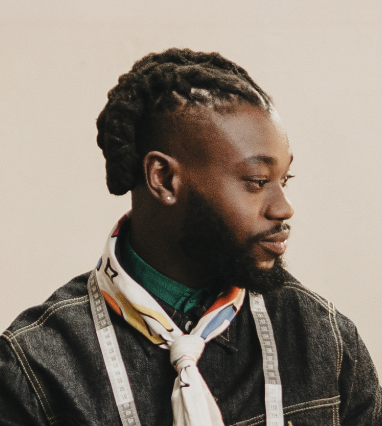
Mario Alcantara-Monteiro, alias DATGRUVEE, is an international UK-based DJ artist and creative hailing from the cities of Lisbon and Luanda. Known for his rigorous yet involving and resonant mixing style and creative aesthetic, DATGRUVEE's musical journey began during his childhood, starring his first club gigs at age 17, ultimately leading him to move to London and performing at venues such as Egg LDN, BoxPark, and Rolling Stock. His sets and productions evolve from electronic jazz and soulful to more poignant and percussive nuances that pay tribute to his indigenous African and Mediterranean roots, along with other Latin and Middle Eastern influences, as he seeks to celebrate the world's musical diversity through his own identity and to take people on a spiritual journey through electronic music. DATGRUVEE has released under US-based Pasqua Records and Italian Double Records, achieving several charting positions on Traxsource with his EP 'Woman' featuring South African DJ producers Soultronixx and DeeCee and 'Your Love' featuring Kelson, Breyth, and Fukisama. He has also been featured on Rinse Radio, Sydney's Fbi Radio, The Beat 103.6, Lisbon's Radio Oxigénio and Luanda's MixFM. In 2023, DATGRUVEE re-launched his very own global electronic music and art project - Ethnik Dance Lab, fostering community-building, exposing local talent, and featuring collaborations with SushiSamba and JUMBI's sister-venue MOKO in London.
INTERVIEW
What first drew you to DJing, and how has your sound evolved over time?
DATGRUVEE: I come from a family and culture where music is used as a form of sharing, healing and peacemaking. There was a sense of harmony whenever music played at home growing up. So eventually I joined the school choir at age 6 and music school for piano at 13 or so. Eventually people would come to me for new music and that led me to launching my music blog at 15 and beginning my DJ journey playing for friends and family at home and school parties. It was my way of giving. Also, my father is a folk music collector and my older siblings introduced me to genres such as jazz, soul, hip-hop, rock and underground electronic music, so there’s quite a rich mix of influences. Initially I would play open format, heavily influenced by family parties in Angola. The sound would range from kizomba, zouk and semba to kuduro, brazilian samba, house music and hip hop. At age 18 I decided to narrow down to house music under the influence of my brother and DJs like Louie Vega, Dennis Ferrer, Atjazz, Kentphonic, Black Coffee and Djeff - Particularly within the soulful, percussive and melodic vibe.
How would you describe the emotions or energy you try to bring to your sets?
DATGRUVEE: I try to orchestrate whatever I am feeling at the moment and match it to what I think would be relevant to that particular set. I’m influenced not only by sound, but also by image, space, scent and even touch. It may darker or brighter, more linear or more fluid - It’s almost unconscious and highly intuitive, so the result is always a consequence of the moment itself, and I think that’s where artwork is created. However, If I was to describe my overall style, I would say articulated, diverse, soulful, progressive and sexy.
Are there any particular artists, cultures, or experiences that have shaped your musical identity?
DATGRUVEE: Absolutely. As I mentioned before, I’m the result of influences from the world - Folk music from the lusophone and diasporic world, electronic and pop music from the west, gospel and house music from South Africa - You name it. If I look back, I would say watching my father record his CD and cassette playlists after dinner played a huge role in igniting my curiosity and musical awareness, and being introduced to live DJ sets from guys like Black Coffee, DJ Demon, Djeff, Louie Vega and Martinez Brothers in my teenage years allowed me to pick my path towards electronic dance music.
The music industry can be intense. How do you take care of your mental and emotional well-being?
DATGRUVEE: That’s a tough one and things like social media made it ten times worse. It takes while for you to learn how to be and respect yourself, and not fall for the rat race, or force yourself into some pre-set box that kills your essence over time. I learned that detachment can be a powerful tool, learning how to disconnect to do other things or to focus on your own ideas when you need it. It’s also important not to spend more time looking at what others are doing than actually doing what you want to do. I need constant reminders of who we are.
Beyond music, how do you see yourself in the world what drives you and your purpose?
DATGRUVEE: Everything I do is for the betterment of human life, starting with my own and then the ones around me. Music and community building just happen to be the first mediums which allowed me to take care of myself and others, but the same can happen with poetry, film, architecture or fashion. I enjoy improving things and finding ways to alleviate the pains of life in non-conventional ways.
Have you faced any challenges in the industry that shaped the way you approach your craft?
DATGRUVEE: That’s a funny one. I recall the time when African house music wasn’t very popular or was very niche in places like London. Very few promoters and clubs would endorse DJs playing anything outside of conventional tech house, techno and others prominent sub-genres. We had to adapt our pitches for a while up until artists like Black Coffee and Culoe de Song truly disrupted the scene. So yes, there have been challenges because sometimes you’re just ahead of the curve, or you’re trying to fit into a scene which does not fit you - And change takes time. In the end It was actually beneficial since I was able to explore and learn from a range of references which I wouldn’t otherwise.
Do you think electronic music is becoming more inclusive? What progress do you hope to see?
DATGRUVEE: I think electronic music is becoming more elitist, unfortunately. We look at raves from the nineties and you would find every single type of human being, from all walks of life listening to a variety of music. This is not the case anymore as the industry adopted a very capitalist culture where financial performance matters more than the essence of the art and the community, as such, you no longer have many grassroots movements and everything seems to be going towards meaningless big headliner shows or the ‘exclusive party’ scene where only the ones who have enough money and connections are able to produce exist. We are missing the point. My hope is that this trend dies out to the point people feel numb enough to crave something real, different and authentic again. Real spiritual and creative connection, you see?
If you could create your dream lineup for an event, who would be on it?
DATGRUVEE: That’s a tough one, but I would say Hot Since 82, Morda, Dennis Ferrer, Djeff, Black Coffee, my comrade Amadeo Carvalho and myself.
What’s a festival, venue, or city you dream of performing at, and why?
DATGRUVEE: Ibiza by a long shot. It’s my favourite place on earth so far. The energy on that island is hard to articulate but there’s a sense of complete harmony which matches the type of music I play perfectly. It’s laidback, open-minded, spiritual and sensual somehow. Club Chinois and Playa Soleil are some of my favourite venues so those would be my picks. Alternatively, I would like to host a great charity fundraising event back in Luanda, the city where I started my musical journey, and a place with so many people and places with unreleased potential.
Outside of DJing, do you have any creative or personal projects you’re passionate about?
DATGRUVEE: I’m currently building the latest iteration of my organisation AL-M-A. It operates a studio-foundation with focus on improving access to creative education and cultural development alongside under represented and diverse communities in the UK, Angola and African Diaspora. Ethnik Dance Lab is our electronic music and art event project and the next London date should be very soon!
SONOS CLUB is an initiative from Sounds of Craft Records, designed to highlight the eclectic electronic music scene through the perspectives of the BIPOC diaspora and marginalized communities, while being open to all.