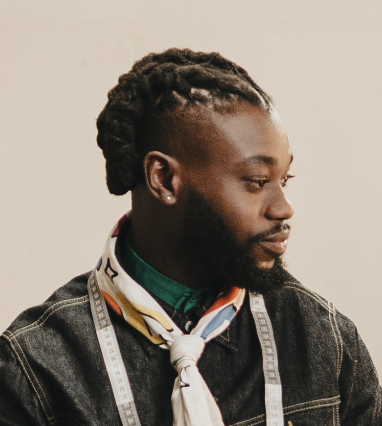
Jay Jay Revlon is a London-based DJ and tastemaker known for blending the sounds of the diaspora — weaving Afrohouse, soulful house, and Afrobeats into seamless, feel-good journeys. With residencies across London's most respected venues and an ear tuned to both dancefloors and intimate spaces, Jay Jay brings energy, warmth, and intention to every set.
INTERVIEW
What made you fall in love with DJing, and how has your approach evolved?
JAY JAY REVLON: DJing found me through Ballroom culture. I came up in the UK House of Revlon and the Kiki scene, where music isn't just a backdrop it's the architecture of an entire world. The DJ is the storyteller, the energetic conductor of a space that is often the safest room in the building for the people inside it. That responsibility is what made me fall in love with it. My approach has evolved from serving a specific scene to building bridges I now read the room in a much broader sense, working across queer club nights, fashion events, art spaces and live performance. The through line is always emotional intention.
How do you create a set that feels personal yet connects with a wider audience?
JAY JAY REVLON: I trust the specificity. I don't try to generalise my taste to make it palatable — I go deeper into what I know and love, and I find that the more specific and honest a set is, the more universally it lands. When I play Ballroom, when I play UK club music rooted in diaspora experience, people who've never heard those sounds before feel something true in them. Specificity is connection.
Are there any unexpected influences that have shaped your musical direction or style?
JAY JAY REVLON: Fashion has been huge. My work at events like 080 Barcelona Fashion Week, the Brit Awards, and Madonna's pre and post-tour parties taught me a tremendous amount about atmosphere, timing and the architecture of a room. Theatre has shaped me too — I've worked with organisations like the Young Vic, Sadler's Wells and the Royal Albert Hall, and those spaces demand a completely different relationship to tempo, silence and build. My photography practice also informs how I DJ. Both are about composition, light and shadow, and knowing what to leave out.
How do you keep your sets fresh and unpredictable?
JAY JAY REVLON: I'm constantly listening. Not just to new releases but to communities — what people are dancing to, arguing about, celebrating. I dig across genres and geographies. And I stay in conversation with the scenes I come from. The Kiki Ballroom world I help build in the UK and Europe is always evolving, always generating new sounds and new energy, and that feeds directly into my DJ sets.
Do you prefer to plan in advance or go with the flow based on the crowd?
JAY JAY REVLON: Both, always in dialogue with each other. I come with a strong sense of where I want to take a room — emotionally, sonically — but I hold it loosely. I'm reading the crowd from the first track. The structure is a framework for freedom, not a rigid script. The best sets I've ever played have pivoted completely in the first ten minutes because the room told me something I hadn't expected.
What's a recent discovery that has helped shape your sound?
JAY JAY REVLON: I've been developing a live performance piece called WHO IS THIS FOR? IT'S ABOUT ME using Ableton Live at Konvent in Barcelona, where I hold a residency. That process — working with production tools rather than just playback — has fundamentally changed how I think about the relationship between a DJ set and a live set. It's pushed me toward more textural, atmospheric territory alongside the dance floor energy I'm known for.
The life of a DJ can be demanding. How do you maintain balance and take care of yourself?
JAY JAY REVLON: Honestly, this has been a journey of learning. I split my time between London and Barcelona, and that physical change of context is genuinely restorative — different light, different pace, different creative energy. I also have a photography practice that is entirely my own, not for hire, not for a brief. Showing work in exhibition spaces reminds me that I am an artist with a full interior life beyond the DJ booth. And community is everything. The young people I work with through LGBTQ+ and QPOC education programmes rooted in Ballroom give me perspective and purpose that no amount of touring could.
What impact do you hope to have on the world at large with your music?
JAY JAY REVLON: I want people — especially queer people of colour, especially people who've been told their culture is niche or underground — to see themselves reflected in the mainstream. Not as a novelty, but as originators. I've had the privilege of playing the Royal Albert Hall, the V&A, Sydney Mardi Gras, Fabric, PACHA Ibiza. I want the path I've walked to widen for the people coming after me.
What's one lesson you'd give to a younger artist about the industry, including inclusivity and diversity?
JAY JAY REVLON: Do not wait for an invitation to a table that wasn't built with you in mind. Build your own table. Let's Have a Kiki, the LGBTQ+ night I founded in London, is celebrating its 10th anniversary this year — because we created the infrastructure ourselves. The Ballroom community taught me that. Inclusion is not a favour someone grants you. It is a door you are completely entitled to walk through, and if it's locked, you find another way in or you build the room yourself.
How do you push forward in a meaningful way?
JAY JAY REVLON: By being rigorous about intention. I ask myself, constantly, who is this for? What is it doing? Is it genuine? That question keeps me honest about the difference between visibility and impact. I run education programmes. I work with institutions like UAL and the Young Vic not just to perform but to pass things on. Pushing forward meaningfully, for me, means always being in relationship with community — not just the industry.
If you could curate a lineup at a festival or venue, who would be on it and why?
JAY JAY REVLON: I'd build it around BIPOC and queer artists who are shaping the underground right now and deserve far bigger rooms. I'd put Ballroom DJs and MCs at the centre — not as a curiosity but as the headliners — because that culture has generated some of the most innovative music of the last four decades and rarely gets its flowers on a festival stage. I'd want the lineup to feel like a conversation across the diaspora: UK, US, West Africa, Brazil, the Caribbean. I'd want it to be joyful, sweaty, political and unapologetically Black and queer. That's the night I've been building toward my entire career.
THE SONOS CLUB is an initiative from Sounds of Craft Records, designed to highlight the eclectic electronic music scene through the perspectives of the BIPOC diaspora and marginalized communities, while being open to all.